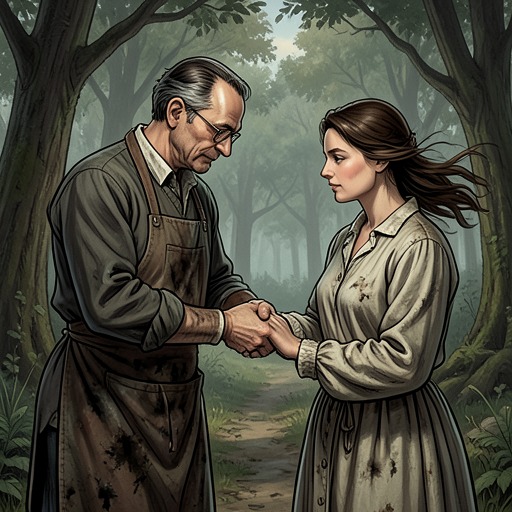
“Going to the village”
Narcissus and Goldmund“Going to the village” is the student expression for slipping out of Mariabronn after dark to pursue forbidden pleasures and returning by hidden routes. The phrase first names an old cloister custom, but its importance lies in how Goldmund experiences it: a clandestine adventure opens the world beyond the walls, then awakens a desire that conflicts with the ascetic future he imagines for himself. Its later recurrence marks the distance between a boy’s tentative transgression and the adult’s irreversible departure.
Meaning and Student Custom
The outing belongs to an unwritten student tradition. Adolf describes a band of hearty classmates, including himself, who occasionally leave the cloister for an evening in the village as a way of reminding themselves that they are not monks. The gates are locked, but that is part of the attraction: students know secret ways back in, and the risk helps make participation a point of honor among the regulars.
Goldmund recognizes the phrase before he is invited. To him, “going to the village” means nocturnal escapades and secret pleasures forbidden under threat of severe punishment. He is drawn in opposite directions: he wants to refuse and return to bed, feeling weak and headachy, yet is embarrassed to disappoint Adolf and wonders whether the world outside might offer something beautiful enough to relieve his discomfort. He finally laughs and agrees, making the choice less from conviction than from curiosity and social pressure.
The First Night Out
The students leave unseen beneath the linden trees. Since the outer gate is locked, Adolf leads Goldmund through the cloister mill, whose constantly turning wheels cover their movements. In darkness they climb through a window onto wet planks, pull one free to bridge a stream, and reach the road leading toward the forest. The ingenuity of the passage and the secrecy of the walk make the transgression exciting; at this stage, Goldmund enjoys the adventure itself.
After less than an hour, they reach a seemingly sleeping village. Adolf guides the group around houses and over a fence into a garden. At a shutter he knocks until someone inside opens it, and the students enter a poor kitchen lit by a small oil lamp. An older servant girl greets them; a younger girl with long black braids emerges from the shadows. The students bring cloister bread and a small paper-wrapped gift, and the younger girl fetches a clay jug of strong apple cider.
The room sharpens the meaning of the phrase for Goldmund. While the others whisper, drink, and exchange timid caresses with the servant girl, he sits apart on the floor, watching the lamp and catching occasional glimpses of their gestures. He wants most of all to look at the younger girl, but forbids himself to do so. The secret walk had seemed like a thrilling breach of rules; being among the girls feels to him like sin. He believes he is destined for the ascetic life of a monk, and the pounding of his heart registers the conflict between that imagined vocation and the desire the encounter has stirred.
Confession and Recurrence
Goldmund later tells Narcissus what happened, approaching the story as something that must eventually be confessed. Narcissus treats the student escapade lightly: forbidden acts can be laughed away or confessed, he suggests, and need not remain a burden. Goldmund objects that Narcissus is speaking like a schoolmaster. Breaking a house rule for a student prank is one thing; for Goldmund, the night in the kitchen has exposed a more serious conflict than disobedience alone.
The phrase returns when Goldmund tries, from time to time, to overcome his estrangement from his classmates. He can make a bench companion laugh or draw a taciturn bed neighbor into conversation, briefly restoring their friendliness. Twice these efforts lead to another invitation to go to the village. Each time he becomes frightened and withdraws. He tells himself he will not go again and manages, almost entirely, to forget the braided-haired girl. Thus the expression comes to signify both inclusion among the students and the desire he cannot comfortably acknowledge.
From Secret Excursion to Departure
The phrase’s most consequential echo comes when Goldmund leaves Mariabronn for good. Tiptoeing under the lime trees and escaping through the mill, he remembers the earlier night with Konrad: then he had been excited and secretly afraid; now he is taking more dangerous, forbidden roads without fear or concern for the porter, the Abbot, or the teachers. The shared route makes the contrast physical. His first exit was a temporary adventure undertaken with classmates; this crossing is a separation from cloister life.
This time no planks bridge the brook. Goldmund throws his clothes to the opposite bank, wades naked through the deep, swirling water up to his chest, and dresses again beyond it. The recalled phrase therefore marks a threshold in his development: the student’s secret excursion had allowed him to sample an outside world while expecting to return, whereas his final passage through the same hidden way begins a life beyond the institution. The repeated wording binds the two departures while showing how far Goldmund has moved from fear of forbidden experience to acceptance of the road ahead.